
Beyond the Statin: Integrated Lipid Management in CKM Care | Dr Rajeev
Updated at : Aug 4, 2026
▶ Read Transcript
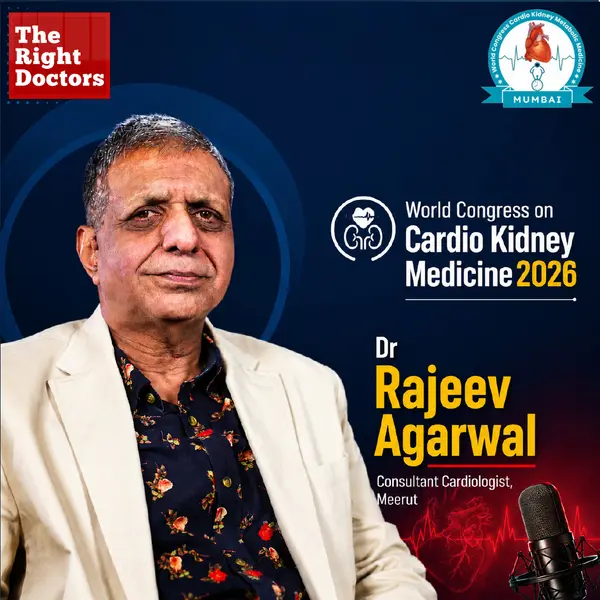
"The crux of the problem is not only the LDL level, but the duration of exposure," says globally renowned interventional cardiologist Dr. Rajeev Agrawal in a conversation with Dr. P.C. Manoria at the World Congress Cardio Kidney Metabolic (WC CKM) Medicine 2026.
This discussion explores the shift from "Lower is Better" to "Earlier is Better" in lipid management. Dr. Agrawal breaks down the future of lipidology, from the "standard duo" of statins and ezetimibe to revolutionary gene-silencing technologies and the quest for effective Lp(a) therapies.
Top 5 Takeaways:
1 LDL "Time-Volume": Risk is about the "area under the curve"—total years of exposure to high LDL, not just a single reading.
2 Birth-Level Targets: Regression of plaque requires dropping LDL to 25–50 mg/dL—mimicking the levels found in an umbilical cord.
3 Obicetrapib's Edge: This new molecule is a "triple threat," lowering both LDL and Lp(a) while significantly raising HDL.
4 Gene Editing Reality: CRISPR technology solves lifelong compliance with one dose but matches the 55% LDL drop seen with daily drugs.
5 The Lp(a) Data Gap: We can now silence Lp(a) by 90%, but we still need final outcome trials to prove this saves lives.
Dr. Rajeev Agrawal is a globally renowned Interventional Cardiologist and a leading authority in Lipidology. He is a senior consultant known for his expertise in complex coronary interventions and preventive cardiology.
Dr. P.C. Manoria is the Executive President for the World Congress Cardio Kidney Metabolic (WC CKM) Medicine and a distinguished cardiologist based in Mumbai.
More From TheRightDoctors


CORONA-VIRUS
The-speakers
RSSDI-JAIPUR-2019
The-speakers


RSSDI-AHMEDABAD-2018
The-speakers
WCCMM-MUMBAI-2019
The-speakers


AOC-MUMBAI-2020
The-speakers
Powered by:

Awards & Recognitions:


