Jul 18, 2026
Two People. One House. Same Rare Disease. The Mystery That Changed How We Think About Graves'.
Two People. One House. Same Rare Disease. The Mystery That Changed How We Think About Graves'.
Dr Chandra Sekhar
UPDATED: May 25, 2026, 6:46:21 PM
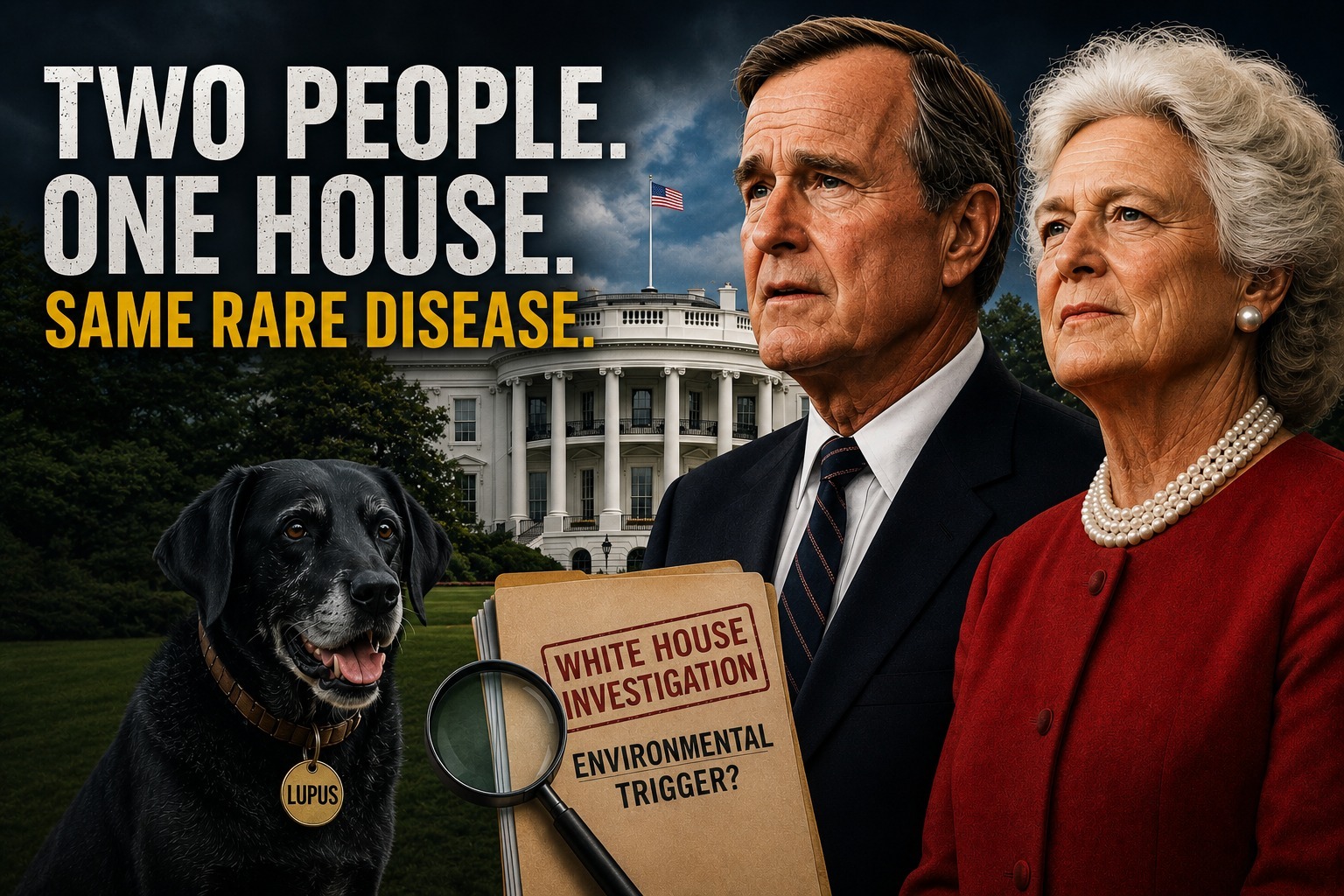
In the spring of 1991, the most powerful couple in the world fell ill with the same rare condition within months of each other.
George Herbert Walker Bush, the 41st President of the United States, was diagnosed with Graves' disease in April of that year. His heart was racing. He had lost weight unexpectedly. During a morning jog he felt his heart lurch into an abnormal rhythm — atrial fibrillation, triggered by the thyrotoxicosis his doctors were only beginning to understand.
Weeks later, his wife Barbara Bush received the same diagnosis.
Their dog Millie had lupus.
The White House medical team, faced with a statistical coincidence that strained credulity, began asking a question that would eventually reshape how endocrinologists think about autoimmune thyroid disease: what was happening in that household?
The Investigation That Found No Answer:
The investigation was thorough. Environmental triggers were examined — the water, the air, the food, potential toxic exposures in the residence. Infectious agents were considered.
The possibility of a shared pathogen that had triggered autoimmune responses in two genetically unrelated individuals living in close proximity was explored seriously.
No environmental cause was ever conclusively identified.
What emerged instead was a theory — supported by a growing body of evidence then and significantly more evidence now — that Graves' disease, like many autoimmune conditions, requires three things to occur simultaneously: a genetic predisposition, an immune system in a state of vulnerability, and a trigger.
The trigger, in the Bush case and in many cases studied since, is most likely viral. A pathogen — possibly a common virus — initiates a process called molecular mimicry in genetically susceptible individuals.
The virus carries protein sequences that resemble proteins on the surface of thyroid cells. The immune system, mounting a response to the virus, produces antibodies that cannot distinguish between the viral protein and the thyroid protein.
The immune attack that was meant for the virus is redirected at the thyroid.
Both Bushes were susceptible. Both were exposed. Both developed the disease.
The dog remains unexplained.
What Graves' Disease Actually Is:
Robert James Graves described it in Dublin in 1835 — a woman with a racing heart, a swollen neck, and eyes that seemed to protrude slightly from their sockets. He did not know what was causing it. He described what he saw.
Carl Adolph von Basedow described the same constellation of findings in Germany five years later, independently. The condition is called Graves' disease in the English-speaking world and Basedow's disease across much of Europe — a naming controversy that persists to this day and reflects nothing more than the accident of geography and language.
What neither Graves nor Basedow could have known is that the condition they were describing is not primarily a thyroid disease. It is an immune system disease that happens to express itself in the thyroid.
The mechanism was not understood until the second half of the twentieth century, when researchers identified thyroid-stimulating immunoglobulins — antibodies, now called TRAb, that bind to the TSH receptor on thyroid cells and mimic the action of TSH.
Instead of the pituitary gland controlling thyroid hormone production through normal feedback, rogue antibodies are sending a permanent, unregulated stimulation signal. The thyroid responds by producing too much hormone.
The result is hyperthyroidism — racing heart, weight loss, heat intolerance, anxiety, tremor, and in some patients the distinctive eye changes that Graves first observed nearly two centuries ago.
The TRAb test is now the diagnostic cornerstone of Graves' disease. A positive result confirms the autoimmune mechanism. It also identifies patients at risk for thyroid eye disease — the orbital complication that occurs when the same antibodies attack the tissue behind the eyes.
The Eye That Graves' Disease Attacks:
Thyroid eye disease is the aspect of Graves' disease that patients find most distressing and that received, until recently, the least effective treatment. The retro-orbital tissue — the fat and muscle behind the eyeball — becomes inflamed and expanded under the influence of TRAb antibodies. The eye is pushed forward. In severe cases the cornea is exposed and at risk of ulceration. Vision can be affected. The changes to appearance can be profound and psychologically devastating.
For most of the twentieth century, treatment consisted of steroids to reduce inflammation and, when the active inflammatory phase had passed, orbital decompression surgery to push the eye back into position. Neither addressed the underlying cause. Both managed the damage after it had occurred.
The approval of teprotumumab by the FDA in 2020 changed the equation. The drug blocks the IGF-1R receptor that drives the retro-orbital inflammation. In clinical trials it reduced proptosis — the forward protrusion — in the majority of patients, and in some cases reversed changes that had previously been considered permanent.
For the first time, a treatment was addressing the mechanism rather than the consequences.
What the Bushes Established:
George Bush was treated with radioiodine ablation — the destruction of the overactive thyroid gland using radioactive iodine taken as a drink or capsule. It is effective, irreversible, and results in hypothyroidism that requires lifelong levothyroxine replacement.
He took a daily thyroid pill for the rest of his life.
Barbara Bush underwent the same treatment. The same outcome.
The President and First Lady of the United States, managing one of the most demanding years of any modern presidency, were both hypothyroid and both on daily levothyroxine — the same inexpensive tablet taken by 42 million Indians.
Their case established several things that remain clinically relevant today.
First, that Graves' disease can cluster in households among individuals who are not genetically related, strongly implicating a shared environmental trigger — most likely viral — rather than pure genetic inheritance.
Second, that the condition does not discriminate by age, sex, or circumstance. The most powerful man in the world was not exempt.
Third, and most practically: when a patient presents with Graves' disease, the clinician should ask about household contacts. Has anyone else in the home developed similar symptoms — palpitations, weight loss, heat intolerance, anxiety.
Household clustering of autoimmune thyroid disease is real, is documented, and creates an opportunity for earlier diagnosis in the contacts of an index case.
The White House doctors found no environmental cause in 1991. But the question they asked — why did two people in the same house develop the same autoimmune disease — pushed the science of autoimmune thyroid disease forward in ways that continue to benefit patients today.
Sometimes the most important clinical advances begin not with a breakthrough in a laboratory but with a coincidence that is too striking to ignore.
------------------------------------------------------------
Dr. Chandra Sekhar is the Founder, CEO, and Editor-in-Chief of TheRightDoctors.
Two People. One House. Same Rare Disease. The Mystery That Changed How We Think About Graves'.
Most Popular

Dr. Enas A. Enas: Targeted Screening Essential to Stop Early Indian CA

Restructuring Macronutrient Ratios Checks Indian Diabetes

Dr. Pankaj Manoria on Post-MI Antiplatelet Therapy Selection

Dr. Peter Schwarz Outlines IDF Strategies for Global Diabetes Crisis
Incorporating Imaging Refines Risk in CKM Syndrome
More From TheRightDoctors
Understanding Systemic Burnout and Policy Initiatives for Doctors
Dr Chandrashekhar: Image Fat Depot Phenotypes | WCCKMM 2026

The Indispensable Role of SGLT2i in Heart Failure

Dr V Mohan Outlines Precision Medicine to Subdivide Indian Diabetes
Trending

Dr. Dorairaj Prabhakaran on Harnessing AI for Cardiovascular Care
Lipedema: Mistaken for Obesity
DR. V.K.SRINAGESH

Vitamin D Supplementation in Patients with Diabetic Retinopathy
Prof. Sandeep Saxena

COVID-19: Effects on the Gastrointestinal Tract & Liver
Dr. Rajesh Upadhyay