World Digestive Health Day: AI Models Optimize Polyp Detection
World Digestive Health Day: AI Models Optimize Polyp Detection
Web Desk
UPDATED: May 29, 2026, 7:54:00 PM
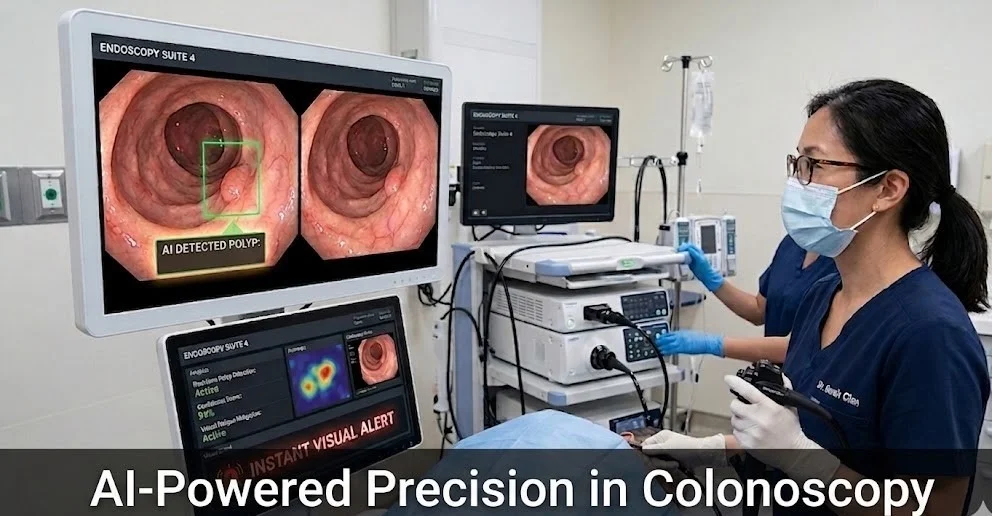
As World Digestive Health Day 2026 draws to a close, Thursday 29 May has served as a global inflection point for gastroenterology — and nowhere is the pace of clinical transformation more evident than in the application of artificial intelligence to colorectal cancer screening.
The clinical efficacy of colorectal cancer screening depends directly on mucosal visualisation, yet minor adenomas and flat, sessile serrated polyps routinely elude detection during standard procedures. Human factors — including visual fatigue, varying clinical experience, and challenging anatomical angulations — limit diagnostic sensitivity and leave patients vulnerable to interval malignancies.
Gastrointestinal innovation data demonstrates that artificial intelligence directly mitigates these human limitations. Current deep learning models process colonoscopy video feeds in real time, providing instantaneous visual alerts that draw endoscopist attention to mucosal irregularities that might otherwise be missed.
A meta-analysis published in Gut, the official journal of the British Society of Gastroenterology, shows that AI-assisted colonoscopy improves adenoma detection rates by up to 30%. This increase in diagnostic precision directly impacts patient outcomes by ensuring the resection of early-stage lesions before malignant transformation.
Prof. Cesare Hassan, Professor of Gastroenterology at Humanitas University, Milan, and lead investigator on multiple AI endoscopy trials, stated: "Computer-aided detection is no longer an experimental add-on — it is rapidly becoming the standard of care. In our trials, AI-assisted colonoscopy consistently detected lesions that were missed on the same-day tandem procedure by experienced endoscopists. The clinical implication is unambiguous."
The software operates with high sensitivity and helps standardise diagnostic quality across diverse clinical settings — a particularly significant development in regions lacking high concentrations of senior specialist endoscopists, a challenge specifically documented by the World Endoscopy Organization.
Advanced machine learning tools are now being trained to perform real-time optical biopsy analysis, differentiating benign from neoplastic tissue instantly. Dr. Prateek Sharma, Professor of Medicine at the University of Kansas and a pioneer in endoscopic imaging research, stated: "Optical biopsy through AI pattern recognition has the potential to eliminate the cost and delay of histopathology for the majority of diminutive polyps — that is a transformative shift in clinical workflow."
This capability will refine clinical decision-making on lesion resection and significantly reduce unnecessary histopathology costs, accelerating the path from detection to clinical certainty. The trajectory is clear: AI-assisted endoscopy is moving from innovation to infrastructure, and the case for equitable global access has never been stronger.
World Digestive Health Day: AI Models Optimize Polyp Detection
Tags: Worlddigestivehealthday Colorectalcancer Artificialintelligence Endoscopy Gastroenterology Medicalinnovation Digitalhealth Oncologyscreening Polypdetection Healthtech Clinicalprecision Cancerprevention Biotech Internalmedicine Digestivehealth Therightdoctors |
Most Popular
Common Errors in Hypertension Measurement: Dr. Kamlesh Tewary
Dr. Kamlesh Tewary
Back Pain During COVID-19
Dr. Kaushik Sil
Lipedema: Mistaken for Obesity
DR. V.K.SRINAGESH
Reminisces of a Surgical PG Student
Dr. Sayandev Das Gupta

Impact of Stress on Health
Dr. Manju Mehta
More From TheRightDoctors
Challenges of Medical Education in India
Prof. Dr. Vitull K. Gupta
Orthopedics: the past, the present and back to the past to deal with the COVID-19 era
Dr N Somasekhar Reddy
Role of telemedicine in COVID-19 pandemic
Dr Hardeep Kaur Grewal
Vitamin D Supplementation in Patients with Diabetic Retinopathy
Prof. Sandeep Saxena
Trending
COVID-19: Effects on the Gastrointestinal Tract & Liver
Dr. Rajesh Upadhyay
Dr Chandrashekhar: Image Fat Depot Phenotypes | WCCKMM 2026
Addressing Healthcare Barriers on World Hepatitis Day 2026