The Twins Who Made Medical History — And the Nobel That Followed
The Twins Who Made Medical History — And the Nobel That Followed
UPDATED: Aug 13, 2026, 10:50:18 AM
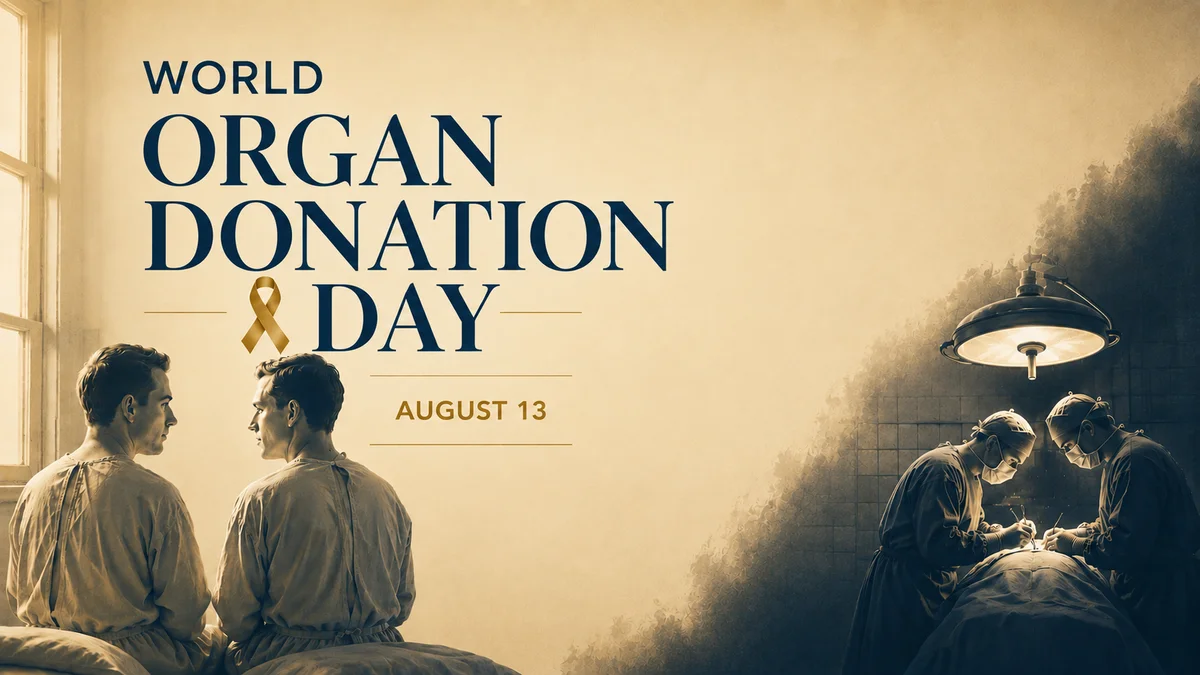
Every year on 13 August, the world marks World Organ Donation Day — a day built on gratitude for donors, and on the quiet, decades-long work of scientists who made donation something worth doing in the first place. It's easy to think of organ transplantation as a modern miracle, one more entry in the long list of things medicine simply learned to do. It wasn't. For decades, the body's rejection of foreign tissue was treated as an unbreakable law of biology — until one Boston operating room, one surgeon, and a pair of twin brothers proved otherwise. What happened on 23 December 1954 didn't just save one life. It rewrote what was considered medically possible, and every transplant performed since traces its lineage back to that single afternoon.
On 23 December 1954, a surgeon in Boston did something no one had ever successfully done: he transplanted a kidney from one living person into another, and it worked — long-term.
The recipient was Richard Herrick. The donor was his identical twin, Ronald. The surgeon was Joseph E. Murray, operating at Peter Bent Brigham Hospital. It was the breakthrough that proved transplantation wasn't a biological impossibility — just an unsolved technical and immunological problem.
Murray didn't stop there. In 1959, he performed the first successful non-identical twin transplant using total-body irradiation. In 1962, the first deceased-donor kidney transplant using chemical immunosuppression. Each one chipped away at the belief — held even by Alexis Carrel, the 1912 Nobel laureate who pioneered the vascular suturing techniques that made transplant surgery physically possible — that the body would always reject a non-identical graft. Murray's work earned him the 1990 Nobel Prize in Physiology or Medicine, shared with E. Donnall Thomas.
Then came cyclosporine in the late 1970s and early 1980s — the drug that turned rejection from a near-certainty into a manageable risk, and organ transplantation from a medical marvel into routine surgery.
Decades later, organ transplantation has become one of modern medicine's most consequential fields, saving hundreds of thousands of lives worldwide since that first operation — every one of them built on a kidney, two brothers, and a surgeon willing to bet against the medical consensus of his time.
The takeaway: Every gene-edited pig kidney and every digital donor registry today stands on a surgery performed in 1954 that almost nobody believed would work.
The Twins Who Made Medical History — And the Nobel That Followed
Most Popular
Reminisces of a Surgical PG Student
Dr. Sayandev Das Gupta

Impact of Stress on Health
Dr. Manju Mehta
Back Pain During COVID-19
Dr. Kaushik Sil

Vitamin D Supplementation in Patients with Diabetic Retinopathy
Prof. Sandeep Saxena

Challenges of Medical Education in India
Prof. Dr. Vitull K. Gupta
More From TheRightDoctors

Orthopedics: the past, the present and back to the past to deal with the COVID-19 era
Dr N Somasekhar Reddy
Role of telemedicine in COVID-19 pandemic
Dr Hardeep Kaur Grewal

Common Errors in Hypertension Measurement: Dr. Kamlesh Tewary
Dr. Kamlesh Tewary
COVID-19: Effects on the Gastrointestinal Tract & Liver
Dr. Rajesh Upadhyay
Trending
Lipedema: Mistaken for Obesity
DR. V.K.SRINAGESH
Restructuring Macronutrient Ratios Checks Indian Diabetes
Dr. Enas A. Enas: Targeted Screening Essential to Stop Early Indian CA